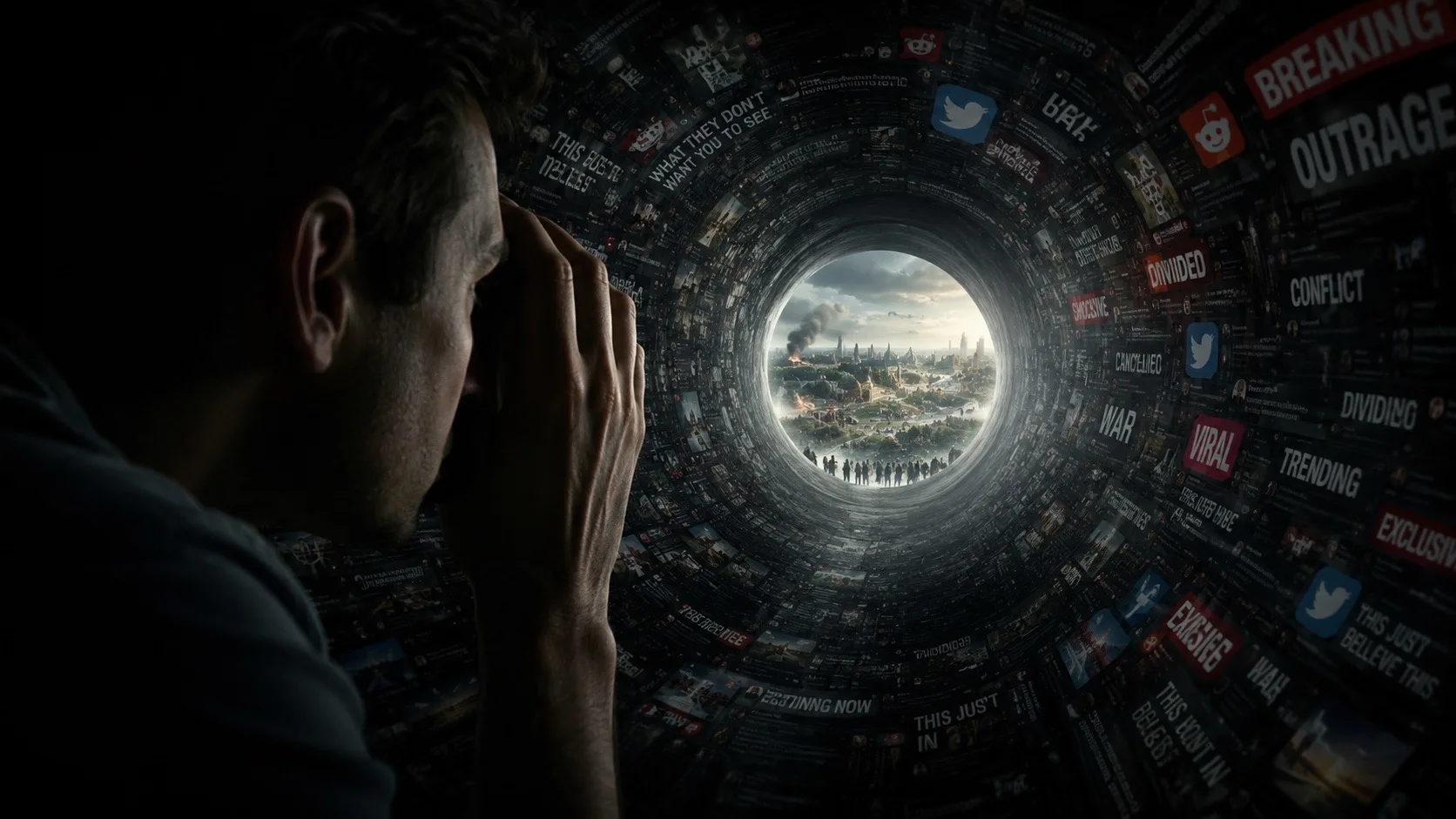
Imagine holding a long cardboard tube to your eye. Through the tube you can see a small circle of the world beyond. What you see is real. The colours are real. The people are real. The events unfolding within that circle are genuinely happening. But everything outside that narrow field of view disappears.
This is how I increasingly think about modern social media.
For millions of people—including myself at times—platforms like Reddit and X have become the primary window through which we observe the world. Wars, elections, technological breakthroughs, natural disasters, crime, politics, scientific discoveries and cultural movements all stream past us in an endless river of information. It feels comprehensive. It feels as though we have our finger on the pulse of humanity.
Yet perhaps we are only looking through a tunnel.
The remarkable thing about social media is not that it lies. Most of what appears in our feeds is based on genuine events. The distortion comes from selection rather than fabrication. Out of the billions of moments that occur every single day, only a tiny fraction become visible. Those moments are rarely ordinary. They are dramatic, emotional, controversial, frightening, inspiring or unusual because those are the moments most likely to be shared, discussed and amplified.
The result is a world that appears permanently on the brink of collapse or transformation.
Spend an hour scrolling and you may conclude society is consumed by political outrage, international conflict, financial collapse and social division. Yet step outside and the overwhelming majority of people are simply living their lives. They are walking their dogs, taking children to school, repairing engines, cooking dinner, falling in love, caring for elderly parents, studying for exams, planting gardens and chatting with neighbours. These ordinary moments almost never trend, despite representing most of human existence.
The tunnel shows what is exceptional while hiding what is typical.
Algorithms reinforce this effect. Their purpose is not to provide a balanced representation of reality but to maximise attention. They quickly learn what captures us emotionally. If anger keeps us scrolling, we receive more anger. If conflict captures our attention, more conflict arrives. If technological breakthroughs fascinate us, every new AI announcement finds its way into our feed. Over time, the tunnel narrows even further until it reflects not only the world’s most engaging moments, but specifically those that resonate with our own interests and beliefs.
Each of us therefore inhabits a different tunnel.
Two people can spend hours on the same platform and emerge with completely different understandings of reality. One believes artificial intelligence is transforming civilisation overnight. Another believes crime is spiralling out of control. Another sees financial catastrophe around every corner. Yet another concludes the world has never been healthier or more prosperous. None of them are necessarily wrong. They have simply observed different slices of an impossibly large reality.
This is perhaps the greatest illusion created by modern information technology: the feeling of completeness.
Never before have ordinary people had access to so much information, yet never has it been easier to mistake an infinitely small sample for the whole. We confuse awareness with understanding. We mistake frequency of exposure for frequency of occurrence. We assume that because we see something repeatedly, it must be happening everywhere.
But reality is vastly larger than any feed.
The world contains billions of people living billions of unique lives across thousands of cultures, languages and communities. It is filled with quiet acts of kindness that never go viral, scientific progress that never trends, friendships that never become posts, and ordinary happiness that generates no engagement metrics whatsoever.
Social media is not the world.
It is a lens.
A powerful one. A valuable one. Often the fastest way to learn about breaking events or hear voices from places we could never otherwise reach. But it remains a narrow aperture aimed at an incomprehensibly vast landscape.
Perhaps the healthiest approach is not to abandon the tunnel, but to remember that it is a tunnel. To occasionally lower it from our eye and look around. To walk outside. To talk with people who are not represented by algorithms. To experience places that cannot be summarised in a headline or reduced to a trending topic.
Because the world has always been far larger, richer and more complex than any screen could ever contain.
The tube never showed us the whole landscape.
It only convinced us that it did.